Lost in the Wooden Whispers of Nara’s Ancient Temples
Stepping into Nara feels like walking through a living postcard where centuries-old wooden beams rise like quiet guardians of Japan’s soul. I didn’t just visit—I inhaled the calm, traced the curves of curved eaves, and stood beneath roofs that have weathered emperors and earthquakes alike. This isn’t just sightseeing; it’s architectural intimacy. The air carries the scent of aged hinoki cypress, and silence wraps around the temples like a second roof. What makes these structures so deeply moving? It is not only their age or grandeur, but the way they speak without words—of harmony, resilience, and reverence. Let’s wander through stillness, craftsmanship, and the quiet genius of ancient Japanese design.
First Glimpse: Arriving in Nara – A City Where Time Bends
Nestled in the gentle hills of Japan’s Kansai region, Nara unfolds like a slow breath after the rapid pulse of nearby Osaka and Kyoto. As travelers step off the train at Nara Station, the city reveals itself not in sudden splendor, but in subtle transitions. Modern storefronts give way to moss-covered stone lanterns, and the distant silhouette of a five-story pagoda rises above a canopy of maple and cedar. The pace shifts—deliberately, almost ceremonially. This is not a city built for haste. Instead, Nara invites a kind of mindfulness, where every footstep seems to echo through layers of history.
The walk from the station toward Nara Park serves as a quiet overture to the architectural wonders ahead. Along the path, sika deer—Nara’s gentle, free-roaming ambassadors—graze near shrines and pause with quiet curiosity as visitors pass. These deer, considered sacred since the 8th century, add to the sense that Nara exists slightly outside ordinary time. Their presence blurs the line between nature and sanctuary, a theme echoed throughout the city’s design. Streets curve gently rather than cut sharply, and buildings rarely rise above two stories, preserving the skyline’s humility.
What makes Nara’s urban fabric so compelling is its refusal to choose between past and present. Convenience stores stand just blocks from temples that predate European cathedrals. Yet there is no clash—only coexistence. This balance is intentional, rooted in a cultural ethos that values continuity. The city’s layout, influenced by ancient Chinese geomancy and Japanese reverence for natural harmony, guides movement with grace. Visitors are not rushed into spectacle; they are led into it, as if the city itself is whispering, Wait. Look closer. This measured approach enhances appreciation for traditional Japanese aesthetics, where beauty lies not in boldness, but in restraint, subtlety, and the quiet dignity of wood shaped by time and care.
The Grand Silence of Tōdai-ji: Scale That Humbles the Soul
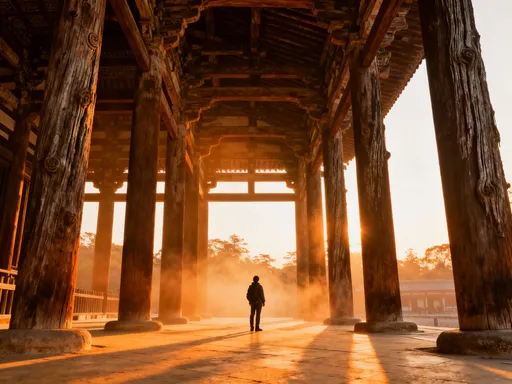
At the heart of Nara lies Tōdai-ji, a temple complex so vast it once served as the central religious institution of the entire Japanese nation. Its Great Buddha Hall, or Daibutsuden, stands as one of the largest wooden buildings in the world—a title it has held, with brief interruptions, for over twelve centuries. To approach it is to feel the ground shift beneath you, not physically, but emotionally. The scale is not merely impressive; it is humbling. The hall measures 57 meters long, 50 meters wide, and 48 meters tall—dimensions that dwarf even the most confident visitor.
What is most astonishing is not just the size, but the method of construction. Built without nails, the Daibutsuden relies on an intricate system of interlocking timber frames, a technique known as nageshi and tokyō, where beams fit together like pieces of a celestial puzzle. These joints flex during earthquakes, absorbing energy rather than resisting it—a testament to the wisdom embedded in traditional Japanese carpentry. The primary wood used is Japanese cypress, or hinoki, chosen for its straight grain, natural resistance to rot, and delicate, enduring fragrance. Even today, restoration projects use only this wood, sourced from sustainable forests, to maintain authenticity.
Inside, the air is cool and still. Sunlight filters through high windows, catching dust motes that swirl like tiny galaxies around the massive bronze figure of Vairocana Buddha. Seated on a lotus throne, the Great Buddha gazes forward with eyes half-closed, exuding a calm that seems to slow time itself. The hall, though rebuilt multiple times—most recently in the 18th century—has preserved its original orientation and proportions. Every column, every beam, every joint speaks of a lineage of craftsmen who passed down knowledge not through books, but through hands-on apprenticeship. This continuity is part of what makes Tōdai-ji so powerful: it is not a museum piece, but a living tradition.
The emotional impact of the Daibutsuden comes not just from its size, but from its silence. There are no loud guides, no flashing lights, no crowds pressing forward in haste. Visitors move quietly, some bowing, others pausing in reflection. The architecture does not shout; it whispers. And in that whisper, there is reverence—not only for the Buddha, but for the generations of artisans who built something meant to last, not for glory, but for grace.
Eaves and Symmetry: The Poetic Language of Rooflines at Kōfuku-ji
Just a short walk from Tōdai-ji, Kōfuku-ji Temple offers a different kind of majesty—one defined not by scale, but by rhythm and elegance. Dominating the skyline is its five-story pagoda, a slender tower that rises like a flame toward the heavens. At 50.8 meters tall, it is one of Japan’s tallest wooden pagodas, yet it carries no sense of heaviness. Instead, it feels buoyant, as if held aloft by the very air around it. Each level diminishes slightly in size, creating a visual cadence that draws the eye upward, step by step, like climbing a ladder of light.
The pagoda’s design is not merely decorative; it is deeply functional. Its layered eaves, each curving gently upward at the corners, serve multiple purposes. They extend far beyond the walls to protect the wooden structure from rain, a necessity in Japan’s humid climate. The upward curve, known as muromachi-buki, is not just aesthetic—it helps shed water more efficiently and allows for better airflow. But beyond utility, this curve carries symbolic meaning. In Japanese architecture, upward-reaching lines suggest aspiration, a bridge between earth and sky, between the human and the divine.
Light plays a crucial role in how the pagoda is experienced. At dawn, the eastern side glows amber, the tiles catching the first rays like scattered embers. By midday, shadows sharpen beneath the eaves, creating patterns that shift with the sun. In autumn, the surrounding maples turn gold and crimson, framing the tower in seasonal fire. This interplay between structure and environment is intentional—Japanese temple design never sees buildings as separate from nature, but as participants in its cycles.
What is perhaps most remarkable about Kōfuku-ji’s pagoda is its resilience. Though it has burned and been rebuilt several times, the current structure dates back to 1426, surviving centuries of storms, wars, and earthquakes. Its stability lies in a hidden feature: a central pillar, or shinbashira, that runs through the core of the tower but does not bear the weight of the floors. Instead, it acts like a pendulum, swaying independently during seismic activity and counterbalancing the movement of the structure. This ingenious system, refined over generations, allows the pagoda to dance with the earth rather than resist it. Beauty and function, poetry and engineering—here, they are one.
Hidden Harmony: Smaller Shrines and the Art of Subtlety
While Tōdai-ji and Kōfuku-ji command attention, Nara’s quieter corners offer a different kind of revelation. In the Isuien Garden, a meticulously composed landscape of ponds, stone bridges, and winding paths, architecture retreats into the background—yet speaks more clearly for it. Small teahouses, their roofs covered in dark, uneven tiles, sit at the water’s edge like sentinels of stillness. These structures are not meant to impress, but to disappear into the scenery, becoming part of the garden’s breath.
The design philosophy here is one of subtraction. Walls are made of paper-thin shoji screens that blur the boundary between inside and outside. Floors are low, encouraging visitors to sit close to the ground, where the rustle of leaves and the ripple of water feel more immediate. Proportions are human-scaled, never overwhelming. In one teahouse, the entrance is so small that guests must bow to enter—a gesture that is both physical and symbolic, a reminder to shed pride before partaking in the ritual of tea.
Throughout Nara Park, smaller Shinto shrines dot the landscape, often hidden beneath thick canopies of evergreen. These shrines, with their simple torii gates and unpainted wood, follow the shinmei-zukuri style—among the oldest in Japan. Their beauty lies in what is absent: no ornamentation, no bright colors, no grand staircases. Instead, there is purity of form, a commitment to natural materials left in their most honest state. The wood is not sealed or varnished; it is allowed to weather, to gray with time, becoming part of the forest rather than dominating it.
This contrast between grand temples and modest shrines reveals the full spectrum of Japanese architectural thought. Where Tōdai-ji speaks of power and permanence, these smaller spaces speak of humility and transience. Both are essential. Both reflect a worldview in which beauty is not found in dominance, but in balance—with nature, with time, with the self. For the visitor, moving from the monumental to the minimal is like shifting from a symphony to a single flute: the volume drops, but the meaning deepens.
Craftsmanship in Detail: Joinery, Materials, and the Hands That Build
At the core of Nara’s architectural endurance is a tradition of craftsmanship so precise it borders on the sacred. Japanese carpenters, known as tōryō when serving as master builders, have preserved techniques that have changed little in over a thousand years. One of the most remarkable is the use of mortise-and-tenon joints—interlocking wooden pieces that fit together with such accuracy they require no nails, screws, or glue. These joints expand with humidity, tightening over time, creating structures that grow stronger with age.
The choice of materials is equally deliberate. Hinoki cypress remains the gold standard, prized not only for its durability but for its spiritual associations. In Shinto belief, wood is alive, imbued with spirit, and building with it is an act of communion with nature. Other woods, such as Japanese cedar and zelkova, are used selectively based on their strength and grain. Even the bark is sometimes left on beams for aesthetic and textural contrast, a practice that honors the tree’s original form.
Finishes are minimal but effective. Traditional temples are treated with natural oils and soot-based lacquers that protect against moisture and insects without sealing off the wood’s ability to breathe. Roofs are tiled with clay tiles, often made locally, their weight carefully calculated to stabilize the structure without overburdening it. Every decision, from the depth of a joint to the pitch of a roof, is made with long-term survival in mind.
Today, these techniques are preserved through rigorous apprenticeship programs and national preservation efforts. The Japanese government designates certain craftsmen as Living National Treasures, recognizing their role in safeguarding intangible cultural heritage. Restoration projects at Tōdai-ji and other sites follow strict guidelines: only traditional tools and methods are used, and new wood must be aged for years before installation. This commitment to authenticity ensures that when visitors stand beneath a 1,300-year-old roof, they are not looking at a replica, but at a continuation—a thread of skill and devotion stretched across centuries.
Walking Through History: How Layout Guides the Visitor’s Journey
Architecture in Nara is not just about individual buildings—it is about movement, sequence, and revelation. Temple complexes are designed as journeys, where every step is choreographed to shape the visitor’s emotional and spiritual experience. At Tōdai-ji, the path begins at the Nandaimon, the Great South Gate, guarded by two towering wooden statues of Niō deities. Passing through this gate is symbolic: it marks the transition from the secular world to the sacred.
From there, the path unfolds in deliberate stages. First, the open courtyard—vast and unadorned—invites reflection. Then, the approach to the Daibutsuden, where the hall is not immediately visible in full. Instead, it emerges gradually, its roof cresting above lower structures, then its full facade revealing itself only at the final approach. This technique, known as miyuki or “gradual revelation,” builds anticipation and reverence. It mirrors the Buddhist idea of enlightenment as a process, not an event.
Other temples follow similar principles. At Kōfuku-ji, the path winds past auxiliary halls, each slightly offset from the central axis, creating a sense of discovery with every turn. Gardens are designed to be viewed from specific vantage points, where a single stone or pond is framed perfectly by a wooden veranda. Even the placement of trees is calculated—some pruned to echo the curve of a roof, others left wild to contrast with human order.
This spatial storytelling transforms a simple walk into a narrative. Visitors are not passive observers; they are participants in a centuries-old ritual of approach, pause, and presence. The architecture does not merely house meaning—it creates it, step by step, through the careful orchestration of sightlines, sound, and silence. In a world of instant gratification, Nara’s temples teach the value of slowness, of letting beauty unfold in its own time.
Why These Structures Still Matter: Preservation, Identity, and Peace
In an age of glass towers and digital speed, the wooden temples of Nara stand as quiet counterpoints—reminders that some things are worth building to last. Their preservation is not just about protecting old buildings; it is about safeguarding a way of thinking. These structures embody values that transcend aesthetics: patience, humility, respect for nature, and the belief that beauty arises from harmony, not domination.
Culturally, they are anchors of Japanese identity. Tōdai-ji was once the head of a nationwide network of temples, linking spiritual practice with governance and community. Today, these sites serve as places of pilgrimage, education, and national pride. They are also UNESCO World Heritage Sites, recognized as treasures of humanity. Their survival through fires, wars, and natural disasters speaks to a collective will to remember, to honor, and to continue.
But perhaps their greatest gift is emotional. In a world often defined by noise and fragmentation, Nara’s temples offer wholeness. They do not distract; they focus. They do not overwhelm; they settle. To stand beneath a curved eave, to run a hand along a weathered beam, is to feel connected—to those who built it, to those who have walked here before, and to the quiet pulse of time itself. These are not just buildings; they are vessels of peace.
For women between 30 and 55—many of whom navigate busy households, careers, and caregiving—Nara’s temples offer a rare kind of nourishment. Not escape, but restoration. The same hands that soothe a child or prepare a meal can pause here, tracing the grain of ancient wood, and remember that strength can be quiet, that endurance is its own kind of beauty. In the wooden whispers of Nara, there is a lesson for all: that the most lasting things are not built fast, but with care, with intention, and with love that outlives a single lifetime.